It’s a 7.5

Uncharted 2

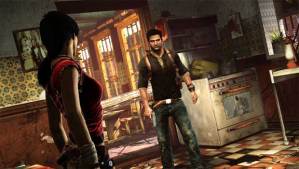
I recently finished Uncharted 2.  I thought the acting and the pacing were excellent.  The story followed a well-worn arc, but had enough unexpected set pieces to keep it fresh.  The combat was dramatically improved over the first game, but still didn’t come together enough to justify the amount of fighting required.  The stealth segments swerved between fantastic and frustrating, often clashing with the combat and story elements.  (We can’t shoot the museum guards, but we can throw them off a roof onto paving stones five stories below?)  I loved the sections where I was working with another character to solve puzzles or fight through enemy territory, partially because I know how difficult it is to do useful AI allies.
Useful _and_ nice to look at?

Maybe "ally" is the wrong word

My main criticism of the game is that it is crushingly linear.  There is only one path, straying from it usually ends in a fail screen, and I could rarely anticipate what was going to happen.  I just followed the breadcrumbs and assumed the level designer knew what they were doing.  On several occasions the game goes beyond leading the player by the nose and starts dragging them by the hair.  If the story required a  pistol with infinite ammo, or a checkpoint to skip me through a tough section, or a hint that told me how to solve a puzzle I hadn’t even seen yet, then gameplay took a backseat.

All in all, a new high-bar for storytelling in games and a fantastic experience.  I give it a 7.5!  (Which according to IGN means “there are some issues, maybe it lacks ambition or it is repetitive or has too many technical glitches, but I had fun playing it nonetheless and think you will too.”)

Jumper

I also played a game based on the 2008 movie where Anikin Skywalker learns to teleport and Mace Windu tries to kill him… or something.  The control scheme is unique.  Instead of traditional brawler controls, each of the four face buttons represents a cardinal direction and tapping it will teleport you to that side of the targeted enemy and execute a melee attack.  By using alternating buttons, you can “jump” behind an enemy, kick him into the air, and then “jump” to where he will land and hit him again from the other side.  The animations are stellar, especially when you start chaining combos and beating the hair-dye out of the chumps trying to capture you.

Blondes have more fun

It's a Tasersword (tm)

They use the main character’s signature ability in lots of clever ways.  You can use it to travel through walls and find secret rooms or solve puzzles.  There’s a finishing move where you grab an enemy and teleport you both to some remote location like a mile above the Grand Canyon or the middle of Antarctica and leave them there to die.  (Of course, this makes it ridiculous when they use the tired trope of locking you in a room until all the enemies are dead.  Why can’t I just teleport through the door?)  There are even some enemies that are protected from certain directions, requiring you to time your attacks from different directions or risk being blocked.

A mercifully short campaign featuring unusual and well-realized combat mechanics.  I give it a 7.5!

The Game Designer Review Scale

Did I just say that some budget movie tie-in schlock is just as good as the highest rated game of 2009?  What kind of rating system would result in giving them both a 7.5?  What are you doing reviewing games anyway, isn’t this a game design blog?!  The answer is simple.  In the Game Designer Review Scale every game gets a 7.5.  From the latest AAA masterpiece to the quirky indie game to the bug-ridden RPG epic.  Because for the game designer the goal is not to compare or judge the games themselves, but to exercise and strengthen your conscious control of your own experience.

Or a 10.5 at press junkets

Your own games get a 6.5

At the beginning of a project, when you are prototyping a new game mechanic, you are not going to have a polished, tuned experience.  It’s going to be noisy and buggy and awkward.  You are going to need the ability to spot the glimpses of fun, no matter how obscured or faint, even if they only exist for a few seconds at a time.  You need to lower your flow barrier, learn to ignore distractions and technical errors, to focus in on fun gameplay instantly before it slips away.  You need to spontaneously create a polished form of the game through imagination and mental tricks like making your own sound effects and storylines.  All so you can snatch up those seeds and grow them until everyone on the team can see them.

You can practice this form of autoregulation by playing a deeply flawed game as if it were a 7.5.

On the other hand, at the end of the production cycle, when the game is smooth and playing it has become effortless and comfortable, you are going to need to look at it with fresh, critical eyes.  You need to raise your flow barrier and become oversensitive and harsh.  Every tiny flaw needs to become a glaring blight that must be fixed.  Every inconsistency or imbalance, no matter how trivial, needs to break you out of the experience.  You need to be able to put yourself in the shoes of a new player and find every confusing control mapping or unclear mission objective.

And you can practice by playing a truly exceptional game and fixating on the problems until it’s just a 7.5.  You aren’t flattening all games to the same level, you are changing yourself and controlling your experience to learn the most possible.

GDC 2010: Design in Detail VII


But how do I know which initial settings will lead to flow? How do I train myself to set things up the right way? Or an even better question, how to I make myself into a good designer?


Sniping flow is very fragile because it is so easy to break. Distractions, misses, and frustration abound. It can be difficult to focus, especially when you are first setting a game up. They key is to master your own flow so that you can control the amount of distraction it takes to break your rhythm.

First, make yourself easy to entertain, so you while you are setting it up you can put yourself in a mindset that allows you to maintain flow. Practice filling in details that don’t exist yet. I’m not kidding, get your mouth engaged! I make motor noises when balancing the Warthog and say “pew-pew” for guns.  Kids are easy to entertain because they make up the fun as they go along.

Another technique is to play B-Games with an open mind. Try to see the fun in spite of all the problems. If you can’t have fun with an imperfect game, you won’t be able to find the flow in your own imperfect game.


On the other hand, don’t be satisfied with “sorta fun”. Sniping flow is supposed to have a high ceiling. By this I mean that when you get into a flow state, it should be incredibly deep. So don’t sell it short by being too easy to entertain. A good way to learn to do this is to play good games harshly. Play Halo and then rip the hell out of it. (I do!)
Warning: This is going to wreck your ability to play games. That’s ok because you get to make games, which is a lot more fun


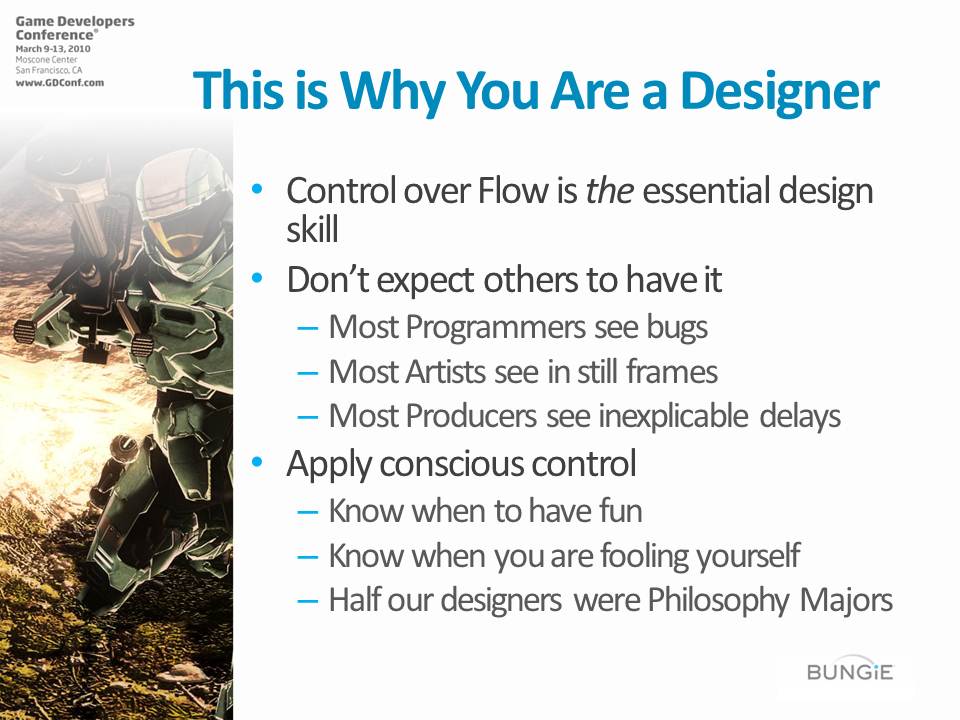
Control over Flow is the essential design skill. In my opinion, control over flow is what makes someone a good designer. Don’t expect other disciplines to have it. Most Programmers see bugs. Most Artists see in still frames. Most Producers see inexplicable delays. But as a designer you should cultivate this conscious control. I imagine a fun thermostat inside my head that I can set at will.


I hate to say it, but most Sniper Rifles aren’t fun. And sniper rifles are easy compared to some things. I believe it is because so many designers skip past this stage and assume that they will be able to make it fun at the end, but find the fun first at all costs! Remember, you aren’t doing Science, you don’t need a control group. Just change stuff and try different configurations. This is why you do this step in private; you don’t need everyone to know all the dead ends you ran down.


Imagine you were trying to teach yourself how to drive. If you just fiddled with one control at a time, you might never figure it out. Pressing the accelerator before you find the ignition doesn’t do anything. You might misinterpret the turn signal until you see how the car operates in motion. Again, this is not science, it is training. You are training your powerful emotional brain through dopamine, and if you leave things static your brain will stop trying to figure it out.


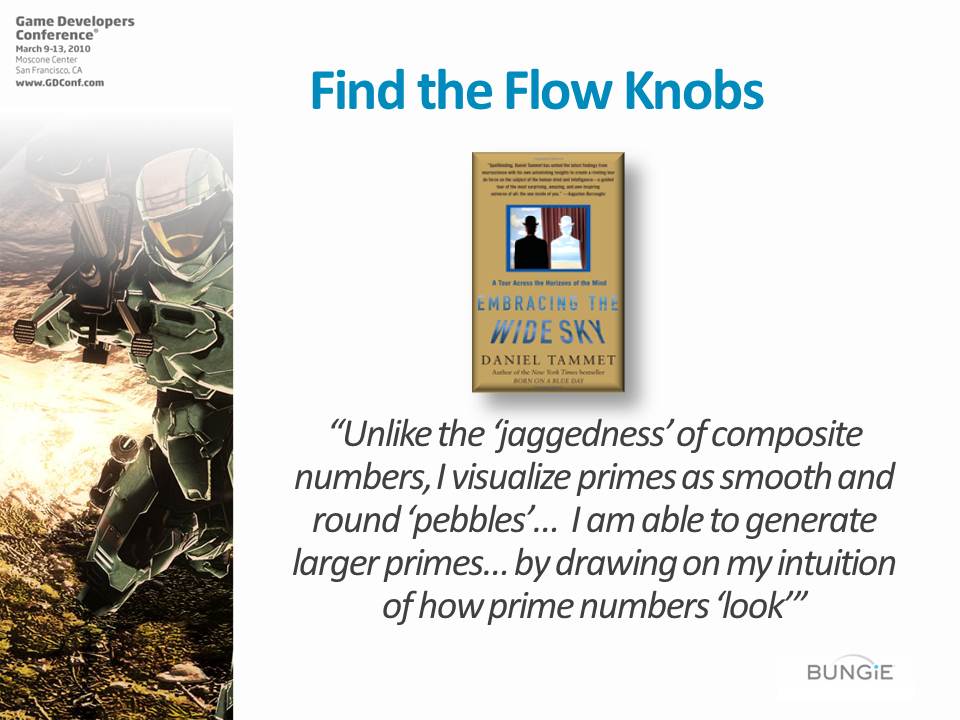
Daniel Tammet has Asperger’s disease and it has given him amazing skill with numbers. He can just intuitively spot prime numbers. Everyone has this power to more or less extent. For me, there is an audible click when something hits the sweet spot, like a record player falling into the groove, that lets me know when something is going to be fun for players.

So, go with your gut!  Trust your heart.  Reach out with your feelings?

To be continued…

Definition: Cadence

Cadence

A pattern of beats and rests that describes a recognizable rhythm and creates a sense of repose or resolution

But first, a verse:

Roses are red,

Violets are blue,

Poetry has cadence,

And so should your gameplay.

What a terrible poem! Any second-grader could write a better one. It isn’t the content; if I simply wanted to argue that gameplay, like poetry, should obey rules of meter and form, it wouldn’t offend your sensibilities. The poem is bad because the cadence is wrong. Instead of resolving the contrasts set up in the first half, the second half breaks the rhythm and leads to a jarring and abrupt end.

In the same way, the wrong cadence can take a good game mechanic and make it feel awkward or even abrasive.  A gun that fires slightly too fast and ends up degrading into a buzz.  A melee combo that is a touch too slow and never feels like it flows smoothly from one hit to the next.  The boss monster whose sweeping tail attack is a little too regular, making it feel robotic and gamey.

There are a few basic components to cadence, and usually just taking the time to notice them is enough to know how they should be adjusted.

  • Tempo – The speed of a cadence, often described by the number of beats per minute.  A good rule of thumb for finding tempos that feel good is to use the same ones found in music.  For instance, the rate of fire of the Halo Battle Rifle is almost exactly the same as the BPM of Queen’s Another One Bites the Dust.
  • Regularity – Some cadences need to be extremely consistent, like a metronome.  The ticking of a clock or the firing of a machine gun sounds mechanical and precise because there is no variance in the cadence.  Others need a slightly irregular rhythm, like footsteps or a series of punches.  Slight variations in the timing leave a more organic impression.
  • Acceleration/Deceleration – Known in music as Accelerando and Ritardando, this describes the way in which a cadence changes from one tempo to another.  Very slow changes in tempo create tension, like a train departing a station.  Quick changes in tempo will attract the players attention, and are great for helping them to anticipate an attack or other event.
  • Style – Some cadences have short, crisp beats (called Staccato), while others feel blended, like pulses (called Legato).  Varying the styles of cadences can change the mood or provide contrast between two game elements.  Having one gun that fires short, separated bursts of bullets and another that emits a continuous wavy beam, for instance, would allow players to choose their own style, and give them a deeper array of options.

 If a game mechanic or other element fulfills its intended role, but still feels unsatisfying or mysteriously broken, try changing the cadence to reinforce and amplify the experience.

GDC 2010: Design in Detail VI


After paper design, we move to initial settings. Usually there is a period in between while the programmers build the system into the game.


Some of the best producers I have worked with really understood the fact that this stage needs some breathing room!


How many of you are familiar with the concept of Flow? Lots of talks have been done on this, I’m going to assume you know what I am talking about, in general.
The problem is, he wrote in the ‘70s, he doesn’t address video games. So what does flow look like in a video game?


Smiling makes you happy; laughing makes you healthy. Certain finger movements make you have flow. We call that Cadence! This timing for the Sniper Rifle is very specific, because the cadence determines the type of flow created. It is different for different weapons or different parts of the game, but cadence is important in all kinds of flow.


Verisimilitude: the quality of seeming to be true. For controls this means that the physical action of your character in some way corresponds to (or at least doesn’t clash with) the action taken by the player. Remember the Paper Design for Halo 1? It speculated that zoom was on a trigger. If I could go back in time, it probably would be.


The sniper rifle doesn’t unzoom as soon as you fire your last shot (even though that would be more efficient). It unzooms with a slight delay so you can see the results of your last shot. Why is this important?
Studies have shown that blue sleeping pills work better. They are chemically identical, but the placebo effect is enormous. Slow-mo explosions look more “real”. Ask any action director, authentic explosions look fake because we have been looking at slow ones for so long. Your brain has expectations and when those expectations are met, the effect is amplified and that encourages your brain to maintain flow.

Let me tell you a story.


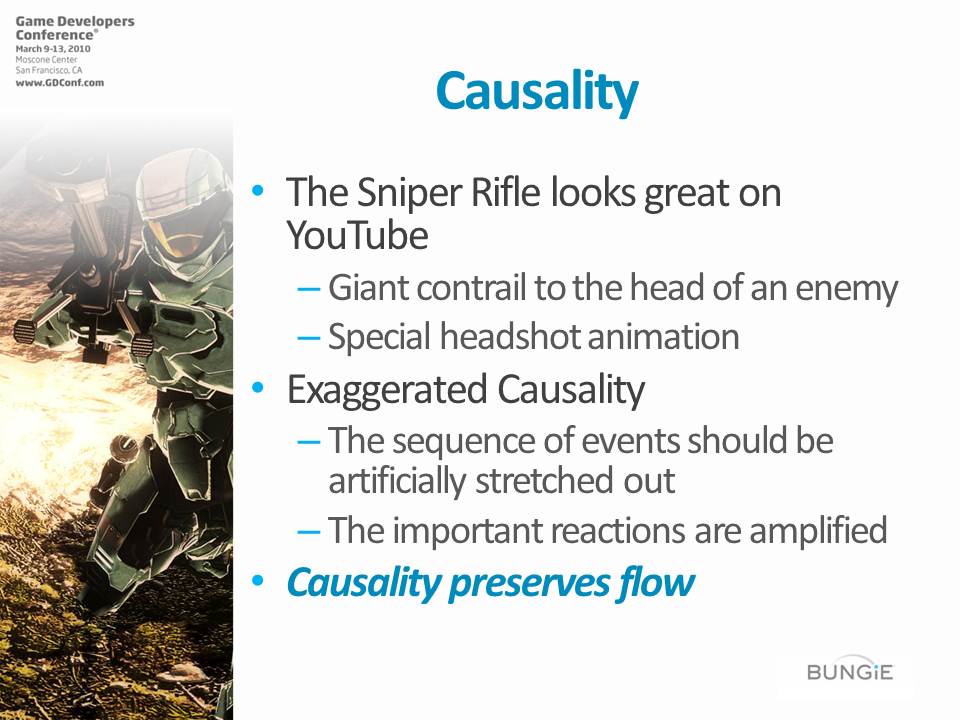
The Sniper Rifle looks great on YouTube because you can really follow the action.  Even someone that has never played Halo can figure out what happened.  Maintining a thread from beginning to end is a key component of staying in the flow state.  For more information, check a specific post I wrote on the topic.

[Continued]

In Anticipation

Most of the time involved in playing any game is spent waiting.  In a turn based board game each player waits for the others in sequence.  Even in a timed chess game the actual portion of the game spent moving a piece from one square to another is much less than the time spent waiting for your opponent or considering your own move.  A play clock in football allows for 40 seconds of inactivity between plays that often last less than 5.  A  tennis match can stretch for hours, with time eaten up not just between volleys, but as one player waits for the ball to be returned (or not) and then moves into a new position and waits for the fraction of a second it takes the ball to reach him.  Even in an intense bout of Street Fighter, the actual portion of time spent pressing buttons and taking meaningful game actions is suprisingly low.

Take all the time you want

It could be argued, then, that most of what we call gameplay consists of waiting.  Not passive, disinterested idleness, but active, focused anticipation.  One key to understanding why a game is fun lies in analyzing the type of anticipation it creates and how a player experiences that expectant state.

Anticipation of the Unknown

The player has no idea what might happen next.  While every experience begins with this form of anticipation, it is the least desirable.  The power of the mind is its ability to creatively construct predictions, of the future, of the underlying nature of reality, of the internal state of another person, and when it starved of information it becomes inactive.  “Anything can happen” is not a statement of possibility, but of unintelligible chaos, and it is a very uncomfortable place to be.

Anticipation of Result

Heads or Tails?  Rock, Paper or Scissors?  Red or Black?  Who wins, who loses?  This type of anticipation occurs when we have a stake in the outcome, but no control or predictive insight.  We are wired to make sense of the world, and when something resists, it itches.  In the absence of actual patterns, people invent them, which is the basis for superstition and our utter inability to intuitively comprehend randomness.  Engaging curiosity in this way is a useful tool, especially if failure is not punished, but if it never pays off it turns to frustration.

Anticipation of Evidence

We know the hero is going to save the day and get the girl.  Screenwriters understand that their audience wants a comfortable trope and if they violate this tacit desire the focus groups will force a re-write.  But we don’t know how, when everything looks impossibly bleak, the hero will turn the tables.  We are anticipating the moment where the pattern is revealed, the hidden trump card appears, and our faith in the Hollywood formula is proven correct.  This kind of anticipation is present in puzzle games where we know there is a solution, but we aren’t sure what form it will take or how we will discover it.  Nothing is more infuriating than a puzzle we know we are intended to solve, but can’t.

The World before Walkthroughs

Anticipation of Action

This is the primary form of anticipation found in games.  The player knows that soon it will be their moment to act, has a model for making predictions, and is excited to test that model against reality.

  • Queued Action – The simplest form of anticipated action.  The player knows what they intend to do and are merely waiting for the opportunity to execute.  As soon as the game begins, I will move my Queen’s Pawn forward two spaces.
  • Queued Reaction – Preparing to respond to an event, either in the environment or initiated by another player.  Because there is only one prepared action, the response time will be as short as possible.  The instant they stick their head around the corner, I’m going to open fire.
  • Multiple Queued Reactions – Mentally preparing for multiple possible events and focusing on distinguishing between them quickly.  If the ball comes to me, I’ll catch it.  If it goes to the outfield, I’ll be the cut-off.  If it goes toward first base, I’ll cover second.
  • Inductive Prediction – Trying to guess what an opponent will do and act preemptively at the right moment.  (David Sirlin calls this Yomi, or “knowing the mind of the opponent”.)  I bet they are going to try a jumpkick, so I’ll throw my fireball to catch them on the way up.
  • Deductive Prediction – Using knowledge of a player’s available actions to reduce the number of reactions that must be prepared.  He’s carrying the sniper rifle, so I bet he isn’t going to rush my position.
  • Forced Prediction – Performing an action for the sole purpose of forcing another player to make a predictable response, with the intention of capitalizing on it.  In fencing this  is called a second intention and happens when you are driving an opponent to react to your attacks instead of taking the initiative themselves.  I’ll fire at his feet with my rocket launcher, which will force him to jump into the air and leave him unable to dodge my second rocket.

One important aspect of game design is intentionally inserting gaps in the action to allow for the desired anticipation.  A simple game that has too few possibilities or happens too slowly will fail to fill the time between actions and become dull or predictable.  A game that is overly complex or happens too quickly will cut short the player’s anticipation and feel out of control or chaotic.  Giving the player control over the pacing may encourage them to over-think their actions.  A small change in the cadence of a game, or providing more or less predictive information, is often enough to change type of anticipation, which is a powerful tool for adding gameplay variety.  Understanding and tuning anticipation is crucial to crafting a fun experience, because once anticipation is gone, boredom sets in.

GDC 2010: Design in Detail V


The second way to develop a sense of balance about paper designs is to look for anticipation. (Anticipation really isn’t the right word for it, maybe “Imperfect Predictability”?) If you make players guess, they won’t see the point and will quit. If you don’t give them a chance, they will feel controlled and quit. Balance means probable, but not inevitable, future events. This allows the player to anticipate them.


Don’t your players into ridiculous movie villains.


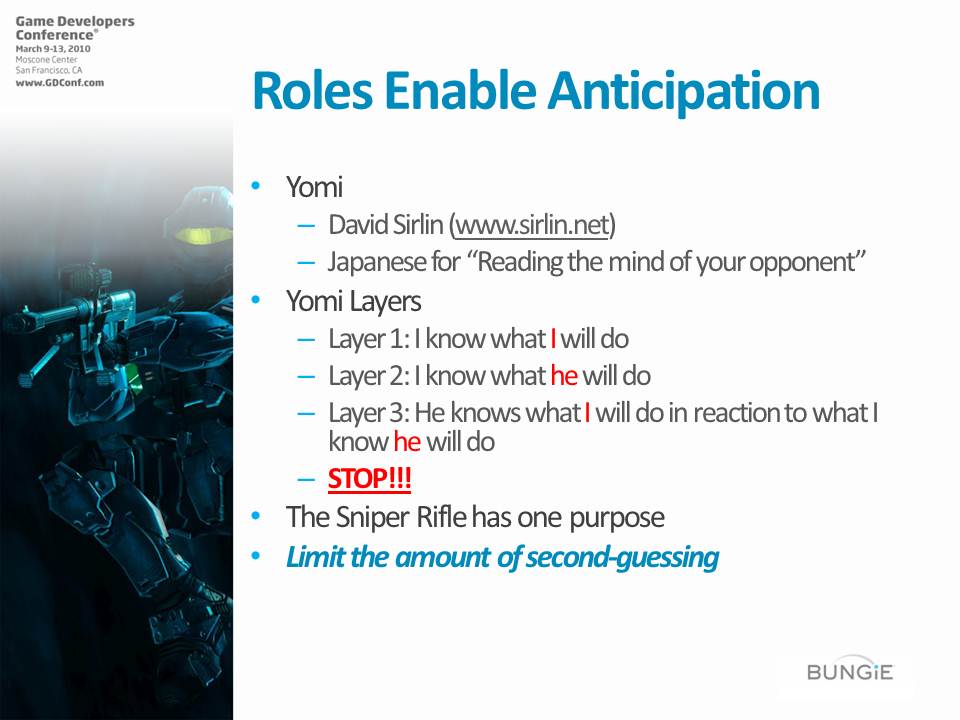
David Sirlin (sirlin.net) is a SF Champion and a game designer (and just happened to be in the audience when I gave this talk at GDC.) He calls this concept Yomi.
In an action game like Halo you don’t want players to engage in this kind of second-guessing. It will paralyze them from acting and end up in random guessing. The Sniper Rifle has one purpose; you know what someone with a sniper rifle is going to do. The role prevents you from guessing by allowing them to anticipate what is going to happen. If they are expecting an event, they can process it more quickly and follow the action better.


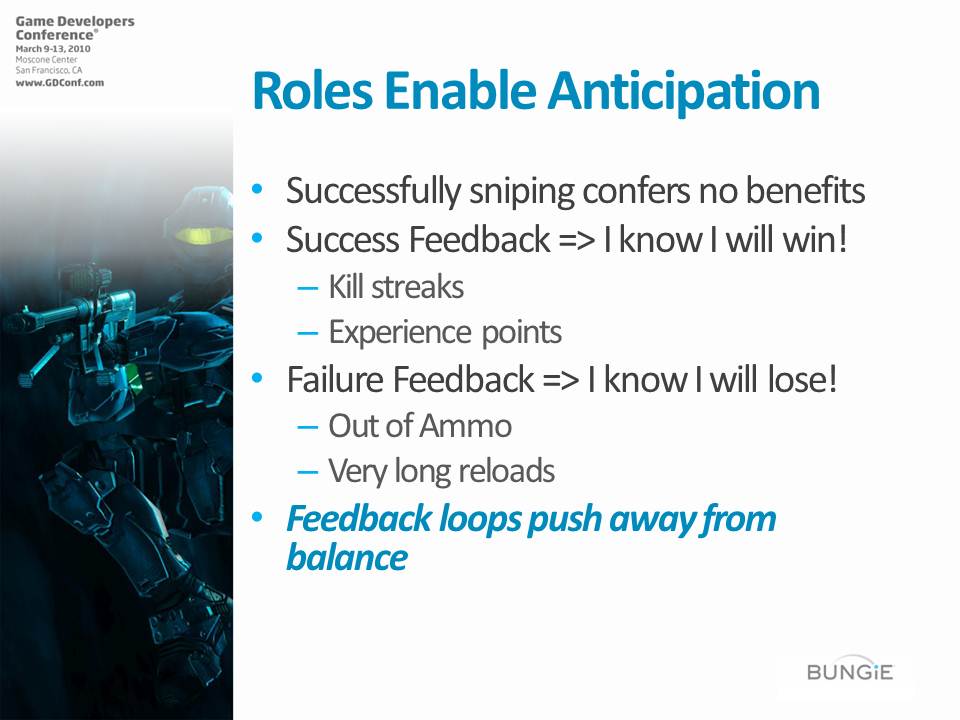
Successfully sniping confers no benefits. As designers, we throw around the term “Feedback Loop” a lot, but they are not always good because they lead to a game being overly predictable. Anticipation requires uncertainty, and feedback loops work against that.


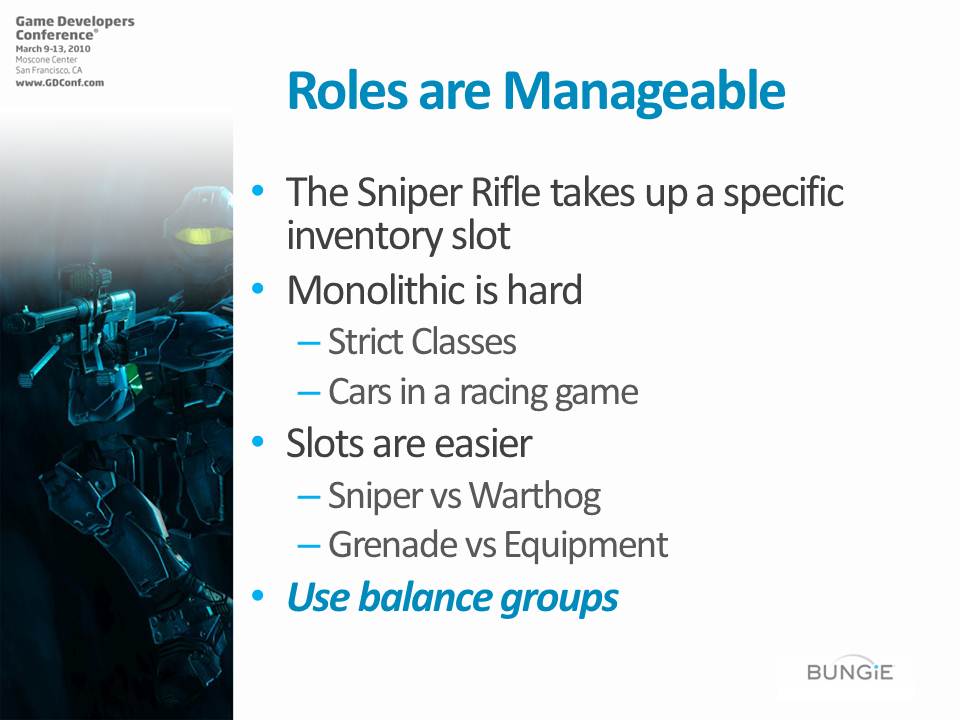
The best thing about roles is that they help you keep things manageable by breaking the design into workable parts.


If you are using roles, make sure players always have other options. The Sniper Rifle is never your only option, so the entire balance never rests on one weapon. By using multiple gameplay channels you reduce the difficulty of your balance problem.


If you break up the balance into groups that do not require cross-balancing your problem becomes simpler. I won’t say that monolithic is always bad, just harder.


The Sniper Rifle is not on every map. This limits the number of possible interactions that need to remain balanced.


Imagine somebody is holding a gun to your head… There is too much to do, what are you going to cut! What are you going to do? How can you get control of your scope? By making the hard choices…


What are the hard choices in the paper design pass? Which mechanics will you emphasize? How will you engage the player’s imagination?


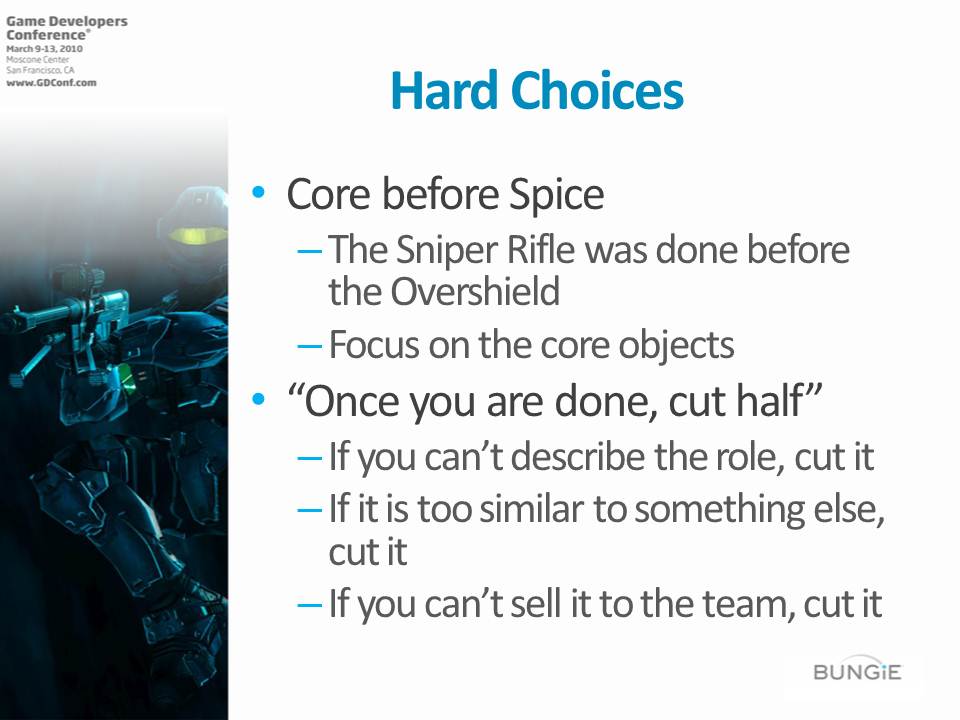
Producers, please insert your fingers in your ears at this time. Some of the best advice I ever got was “Once you are done, cut half” and I have never regretted doing this. I’m not going to say “Kill your babies” Now that I am going to be a dad, the term doesn’t seem appropriate anymore. How about “Put your babies up for adoption”?

To be continued…

GDC 2011

[Update]  I’m back in Seattle and (mostly) recovered.  Thanks to everyone that came to either of my User Research or Game Design talks.  Special thanks to all the readers that introduced themselves; it seems like I am reaching my intended audience of “veteran game designers”.  A narrow demographic, to be sure.  Unfortunately, I spent too much time networking and not enough time attending interesting sessions, but I may cheat and do a wrap-up based on the GDC Vault at some point.

—-

No posts this week.  Between a vacation and delivering two talks I just don’t have time to write anything worthwhile.  If you are going to be in San Francisco, you can catch me here:

  • March 1st at the Game User Research Summit on “Useful Research: Recommendations Designers will Actually Act On”
  • March 3rd at the Game Developer Conference proper on “Design in Detail:  Tuning the Muzzle Velocity of the Plasma Rifle Bolt on Legendary Difficulty across the Halo Franchise”

If you are in the audience and read the blog, please come up afterword and say hello.  I’d love to find out who is reading this thing and get your feedback face-to-face.  I’ll also be posting summaries and responses to the lectures and panels I attend when I get back.

GDC 2010: Design in Detail IV


How do you develop your sense of balance for paper designs? It can be done, you can look at a paper design and have an intuition about how it will work. You are looking for the role, and for a couple key factors that are the results of the role.


The first thing you are looking for is to make sure the paper design is neither too simple, nor too complex. If your paper design is one sentence long, it is probably too simple. People are going to reach the limitations quickly and stop playing. (Remember, balance is longevity)

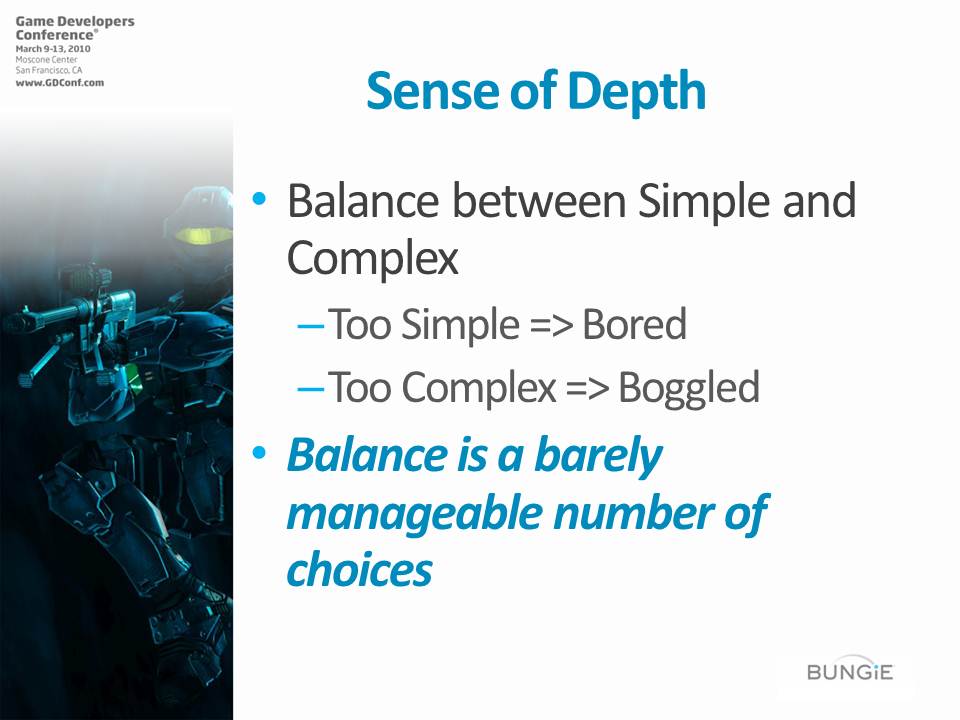
If it is more than a page long, it is likely too complex. People will never reach their comfort level, they will stop playing because they can’t understand what is happening. Balance is a barely manageable number of choices. (I bet I end up writing a post on this slide at some point.)


This is where roles come in because they provide depth without increasing complexity.

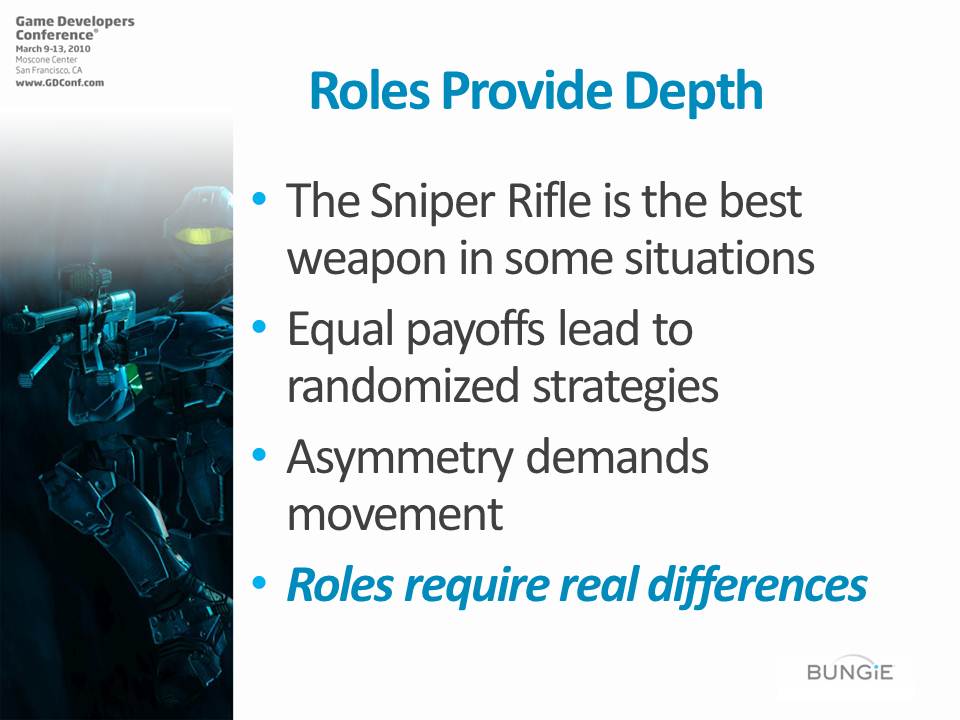
The Sniper Rifle is the best weapon in some situations. The Sniper Rifle has a clear role, times and situations where it is the best. The payoff for using the Sniper Rifle is different depending on what situation you are in. This is good, because game theory tells us that if all the possible strategies have the same payoff, players will pick randomly. As game designers we want to avoid choices that don’t ultimately matter.

Roles are also good because they cause asymmetry, which demand movement. There are incentives to move from one strategy to another depending on the situation.


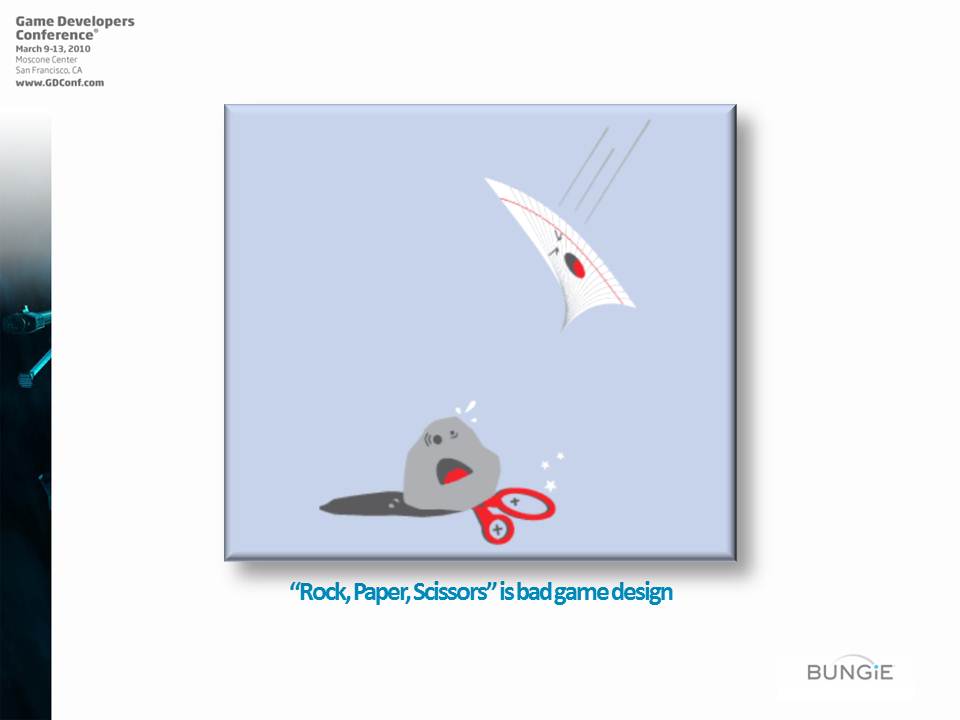
One of the tropes of the design community… Rock, Paper, Scissors. But it’s a terrible game!!! Every choice has the same payoffs, so you pick randomly. There is no player agency if their choice is meaningless.

It’s a cool shirt, though (www.noisebot.com)

This was easily the most controversial slide in this talk. Several people took issue with the fact that RPS is a bad game because many journalists and designers improperly use it to describe a situation where one unit strictly dominates another, like in a good RTS. But imagine a RTS game where you could only pick one unit, you had to pick it before the game started, and if you picked wrong you couldn’t possibly win, It’d be a bad game!
The reason a RTS game works is because it isn’t RPS:
– You can play mixed strategies (choose more than one kind of unit)
– Strategies have different costs to play (tanks cost more than barbarians)
– You can change strategies mid-game
– Strategies rarely have an all-or-nothing payoff (10 Air units can usually kill 1 Anti-air unit)

So I am not using RPS in the casual sense of “a game with counter-strategies” but as defined in game theory; Hopefully that clears things up a bit.

I also got a lot of people saying, “RPS is the foundation of Street Fighter!” This is true, somewhat, more than the RTS case, anyway. but imagine a turn-based game of SF where the first hit wins the match. Again, a bad game.

The reason SF works is that it is also not really RPS:
-SF is a series of RPS interactions, so things like reputation and anticipation come in.
-It is played very quickly, so low level decision making and muscle memory determine your strategy more than choices, so it isn’t truly random.
-And even with that, most non-expert players tend to “button-mash” which is a great example of “random strategy”

Believe me, I am not trying to insult RTS games or SF (or even Ro Sham Bo Tournament Champions) but to encourage designers to see how roles lead to non-equal payoffs, and therefore avoid random strategies.


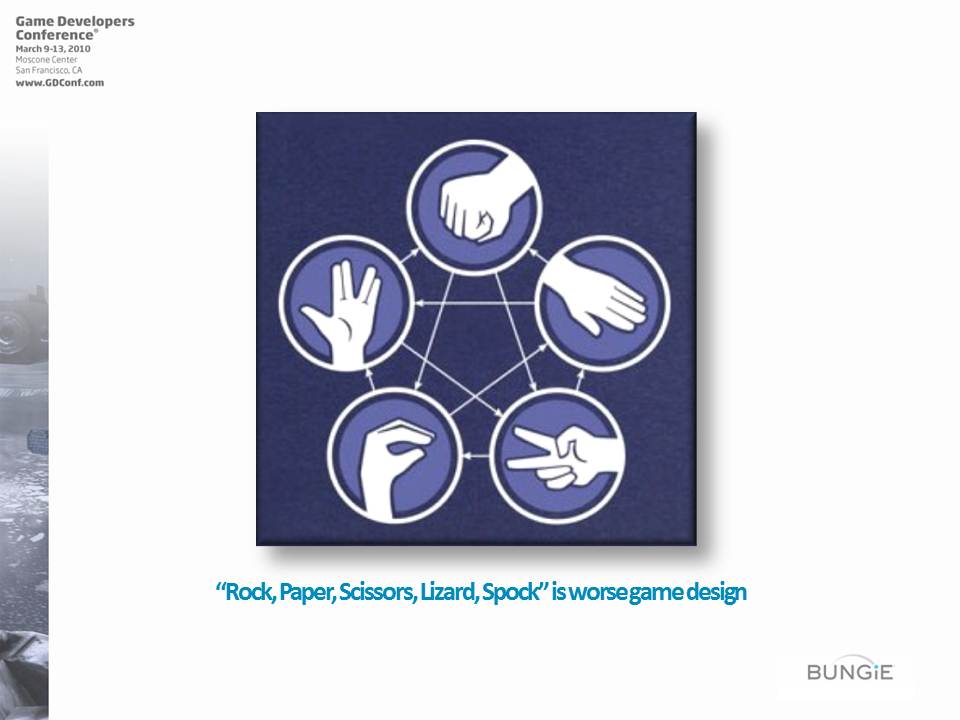
“Rock, Paper, Scissors, Lizard, Spock” is even worse game design. (This game is from the show “The Big-Bang Theory”) It looks more interesting, but it isn’t; it is just more complicated. It will still reduce to equal payoffs and random play.


This doesn’t even make sense! (Interesting note: Halo 1 was this close to shipping without a Shotgun, which makes even less sense…)


Avoid strict dominance…Wait, what is strict dominance?


Who picked the Health Potion? The single-use health replenisher you can buy for 30 rupees?
Who picked the Piece of Heart? The totally unique health-extender you can never buy?

Right, everyone picks the Piece of Heart. (If you didn’t, it’s ok, you were probably eight.)


Iterative deletion means you remove all the dominated strategies, then you remove all the strategies that were only good against those strategies. If you cut the Tank, cut the Anti-Tank Mine. Often when you are making cuts in the final stages of production, it seems like a good idea to cut a little bit from a lot of places, but it is uaully better to cut an entire game mechanic and all of the game elements that use it. Otherwise you end up with several systems that feel like they have missing pieces, rather than a single system that is entirely absent.


After GDC I got challenged to come with an example like Rock, Paper, Scissors that is good game design, so I invented Pirates, Ninjas, Sharks. Each has their own strengths. Ninjas are better at night, but Sharks always win in the water, while Pirates come in crews, etc. A good game is one that you can argue about forever.

[Continued]

GDC 2010: Design in Detail III


The first step in Halo 3 was the paper design.


This is one of about 4 slides for Producers.

The Paper Design should happen in Pre-production. You need to do paper designs first so you don’t have 40 artists sitting around while you do it. On the other hand, if you leave it too early, you are going to waste lots of time later. So as producers, you need to find creative ways to give us room in this stage.

Every gameplay object should get a Paper Design. Don’t let Designers hand wave, because we are great at it! If we can’t write it down it means we haven’t figured it out. Lack of design discipline is a huge threat to your project. On the other hand, if you have a designer that has proven his discipline, then trust his paper design. Take off your design hat before you mess up the game!


Nobody has ever seen this outside of Bungie. It’s the original paper design for the Halo 1 Sniper Rifle. It is embarrassingly simple, but it is better to be simple than overly complicated.


Here’s the important things to note:
Some specifics are wrong. That’s because at some point the paper design is abandoned in favor of the existing object in the game.
Some mechanics are unclear. That’s because it is often difficult to capture an entire system inside a single paper design.
Many details are missing. A paper design should only include crucial or unique information, not every trivial detail.
It’s very flawed as a spec, but one thing comes through, the Role of the weapon.


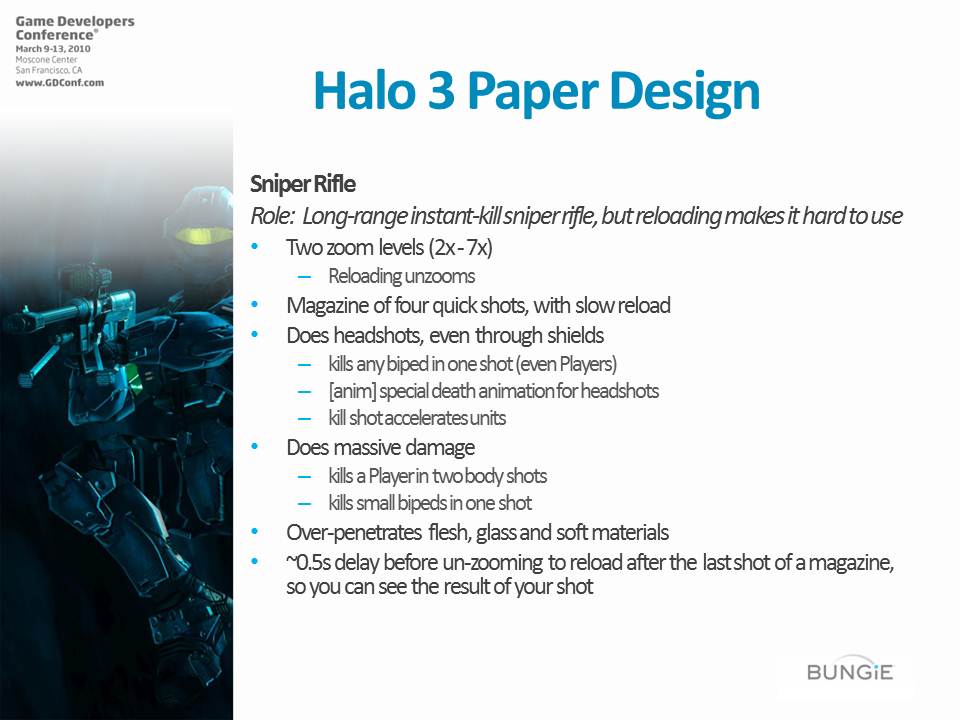
So now let’s look at Halo 3’s paper design. It’s a lot more detailed. But it is still pretty abstract and the role is even more clear. (It ought to be, it was the third iteration!)
It might seem like a waste of time to do a revised paper design since it was essentially the same weapon as the first two games. But it is still important to capture and communicate the vision, because not everyone will have the same understanding of what was important in the previous versions.


“Role: Long-range instant-kill sniper rifle, but reloading makes it difficult to use”
The Role is even more clearly called out. Someone pointed out that Halo has two sniper rifles, which seems to violate the “one weapon per role” rule. Truthfully, they are right, but the missions required enemy snipers using an alien weapon. But, even in that case it is a good idea to give them unique gameplay; that’s why this paper design refers to the fact that the human sniper rifle reloads, instead of overheating.


I felt like this slide failed to capture what is really important about writing a paper design, so I wrote a much more detailed post on the topic.

[Continued]

GDC 2010: Design in Detail II


In order to develop a sense of balance, you need to understand how your brain works. You have an Orbito-Frontal Cortex; It’s called that because it is located behind your eyes, but it’s really your Gut.  When you learn something new, it goes through a process where it builds a model of the world and makes predictions about that model.  If it is right, it releases Dopamine, which cements the model a little bit.

If you are a designer, you need to familiarize yourself with how this process feels, because your ultimate goal should be to get the game inside your head.  You want the model in your gut and the game in the world to be the same.  You should be able to predict how the game will play in a given situation before actually picking up the controller.


Ok, back to Halo 2.  We had to patch, even though we didn’t want to.  Patches are risky and expensive.  Luckily we had network bugs, so we were going to have to patch anyway.  (I’m not sure we would have gotten to patch Halo 2 strictly for balance changes; I’m glad we didn’t find out.)

Choosing what to patch was harder.  You want to tweak everything, but you can’t because then testing gets out of hand.  Games that have the ability to easily change the gameplay often over-patch fopr precisely this reason.

Choosing what NOT to patch was hardest.  We didn’t change the Sniper Rifle because it was right below the line of what we could safely re-balance

Which brings me to my final theme:  Make the hard choices.  Balancing is hard because it requires you to do things you don’t want to.  And it is tricky because there are so many ways to confuse or talk yourself out doing it properly.  But the worst thing you can do is leave the decision up to chance because you can’t make a tough call.


Why are these choices hard?  Again, the answer is your brain.  You also have a Pre-Frontal Cortex.  It’s called that because… Who knows?  We call it your brain.

It is a poor tool, but it’s what we have.  You can’t reason out everything, in fact you can’t reason out very much at all.  There are so many ways that your logical mind has to trick you.  You must confine yourself to reason on the detail scale.  You just can’t hold enough factual information in your brain to make rational decisions about very complex situations.


Radiolab is a great show on New York Public Radio.  They have a podcast, you should subscribe!  In an episode called “Choice” they describe this experiment where psychologists give people a number to memorize, 2 digits to 10 digits.  Then they send them to another room to repeat their number.  On the way, they have someone interrupt them (All good psychological tests are about fooling the subjects) and ask them if they want an Apple or some Cake.

The people with short numbers pick Apples at a high rate; Apples are better for you, fewer calories, watch your waistline.  Those trying to remember longer numbers more often choose Cake.  They are so busy with numbers, they make the decision emotionally.

That’s right, 7-10 numbers are enough to completely fill your rational brain!  My high school calculator had more horsepower than that!

So when you have to think rationally, think about details or you will get hopelessly lost.  And fat.


Ok, here are the four themes of my talk:
– Balance is longevity
– Balance in passes
– Develop your sense of balance
– Make the hard choices

I am going to use these themes to explore the Detail.  Now let’s get to the Sniper Rifle!

[Continue]

GDC 2011 – Design in Detail: The Sequel

Warning: IdeasI’m going to be in San Francisco for GDC where I’ll be giving a talk called Design in Detail: Tuning the Muzzle Velocity of the Plasma Rifle Bolt on Legendary Difficulty Across the Halo Franchise.  It is a follow-up to last year’s talk,which EDGE called “one of the most fascinating sessions of GDC“.  The slides for that talk are publicaly available, but I thought I would lead up to this year’s talk by putting up a director’s cut of the original.  (It will also give everyone something to read while I am on vacation.)

GDC 2010: Design in Detail


Ok, so when I gave this talk at GDC I didn’t have time to finish, even though I was talking very fast.  I did better when I gave it at Blizzard, until my voice ran out and I could barely speak.  So I probably should have cut some ideas out and saved them for this year.

I do see the irony of failing to trim a talk that advices designers to drastically reduce the scope of their game as early as possible.  But to me, the value of GDC has always been that it makes me think about my own problems from a different perspective and inspires new ideas as I listen.  So I wanted to cram as much idea-fodder into the talk as possible, not produce a fluid, polished experience.

I did not make the call on the Pistol, I didn’t even know about that call, it was made directly to the cache file after everything was supposed to be locked down, in fact… but I’m not bitter about it.  I did decide to give the BR some spread, which has been the topic of much debate.  Luckily Reach has been even more controversial, so nobody remembers it anymore.  It’s interesting that every single Halo game has had major controversy over the MP starting weapon, I bet you could write an interesting talk about that.


In 2009 I was at the Art Institute of Chicago visiting my family.  (I grew up in and around Chicago.)  I saw one of the most famous paintings of all time and took a picture of it with my phone.  I actually did have the idea for this talk at exactly that moment, at least vaguely.  Any guesses as to the painting?


It’s “A Sunday Afternoon on the Island of La Grhand Zhot” by Zhorzh Soo-rah (I really wanted to pronounce his name right…heh)  This painting inspired my talk (and its very long title)  Still don’t recognize it?  Here it is from a little farther back.


(I showed you the part in the lower right by the monkey)
This painting isn’t famous for how it looks, or what it shows, but how it was made.


Seurat lived in the 1800’s.  He was very interested in how we perceive color.  Scientists were just discovering that what we see as one color is actually a mixture of different colored light.  To demonstrate this fact, he invented Pointillism, the artistic process of using tiny dots of basic colors to produce an image.  The same way your printer does.

There is a really great play called Sunday in the Park with George that I recommend you see if you are interested in learning more.  You can skip the final act, though.

So I started thinking…  What happens if we take Halo 3 and break it into it’s tiny details…


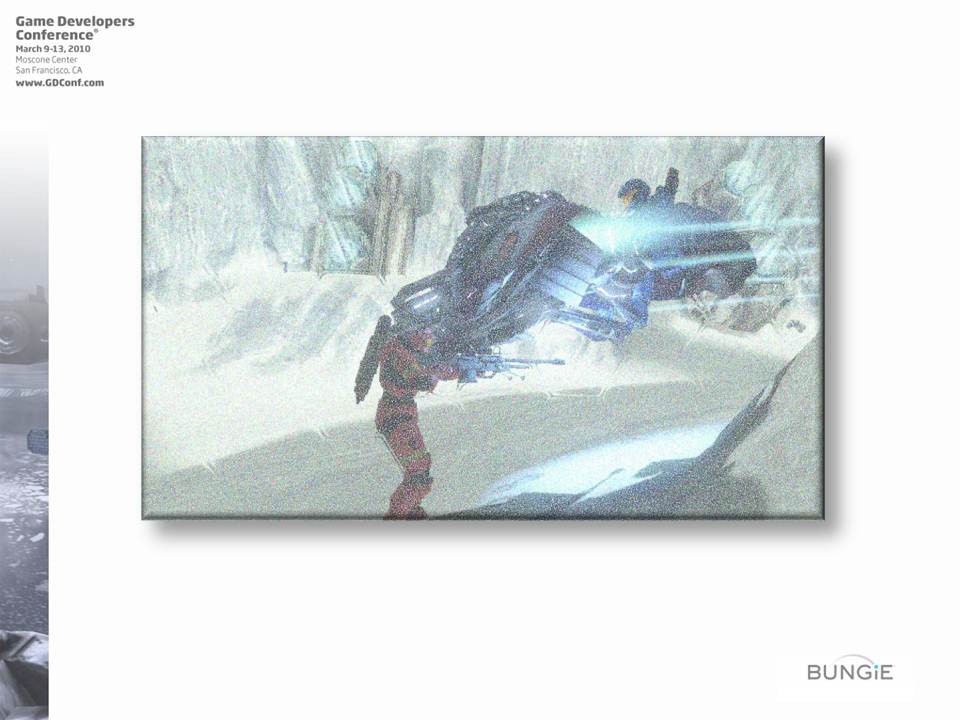
And analyze just one of them.  Take one tiny Decision, and explore it exhaustively.  Specifically, the time between shots for the sniper rifle.  (I had a lot of fun putting together the pictures for this slide deck.  I never tried to pointilize a screenshot before.)


So here is the actual title of my talk.

If you have been to GDC, you know that most of the talks are too broad to be really interesting.  It doesn’t get much more specific than this!  (Of course, I took this narrow topic and used it to explore lots of subjects and theories, but still…)


My opinions may not represent Bungie management.  In fact, I know they don’t.  (If I only knew the irony of that statement at the time!)  My opinions may not represent reality; this is the past as I remember it, but as we will find out, brains are not reliable.  All examples, even negative ones, are from good games.  I tried to pick on games that everyone knows are great, to avoid controversy.

This talk was really hard to write! Really hard. The more specific the topic, the more there is to say.  It ballooned to almost 300 slides, editing took forever (and it turns out I still didn’t edit it down enough!)


First, some context from Halo 2.


Halo 2 wasn’t just popular, it was popular for years and the Sniper Rifle remained balanced the whole time.  It never needed to be changed, limited, banned, it was still fun.

This can give us a practical definition of Balance:  Balance is Longevity.


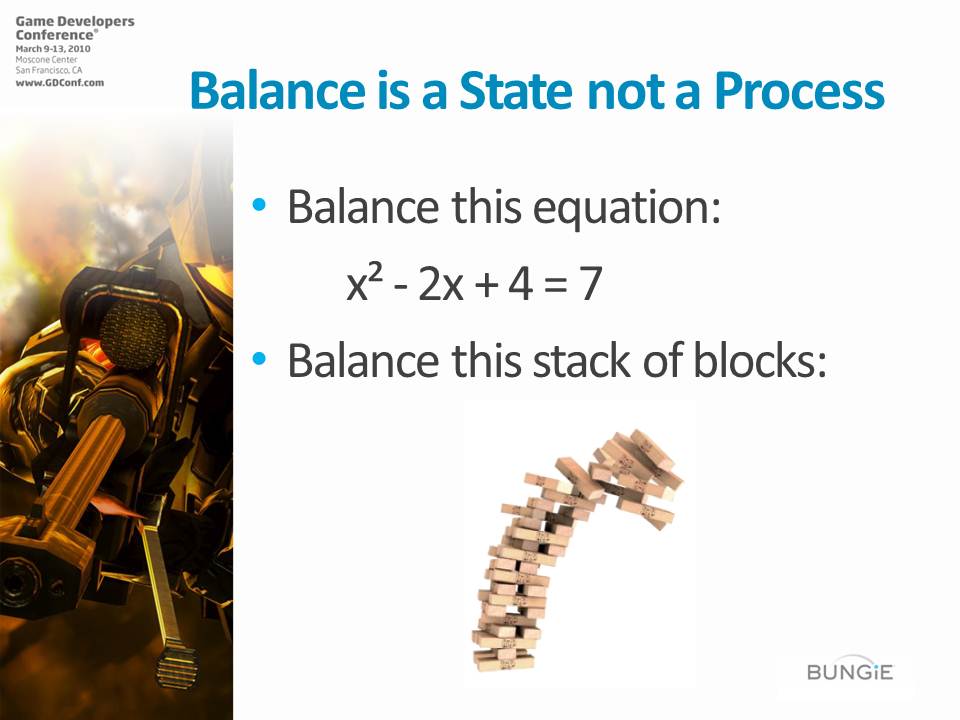
(X= 3, I told them my talk would appeal to Engineers!)

Balancing an equation is a process.  But game balance is a state that either exists or it doesn’t.


The 4th rule of Jenga makes it clear (say it with me):

4. Your turn ends 10 seconds after you stack your block

It isn’t balanced unless it lasts.  (I bet you didn’t expect to see a Jenga reference!)


There have been other talks about Halo 2’s crunch; I’m not going to re-hash them.  My really quick personal post-mortem:  Don’t set yourself up to try and fix bugs in the Tutorial and balance the Weapons at the same time, It’s not going to work.  At least not without wrecking your personal life.

Production is always worried about a repeat.  (As you can tell during this talk, Production and I have a love-hate thing going.  It is mostly a joke, but Deisgn and Production have very different goals and the game is only going to work if they cooperate.)  They were always asking me when I am going to be done, so I invented the Balancer’s Paradox.

Balancer’s Paradox
– I can’t balance the Sniper Rifle damage until we set the Player’s health
– I can’t balance the player’s health until we know the engagement distance
– I can’t balance the engagement distance until we set the Sniper Rifle damage.

But after using this for awhile, I actually had to invent a solution…  Balance in passes.  The Sniper Rifle always has to be balanced! You could ship at any time!  So you keep it balanced all the time.  But there’s balanced, and then there’s balanced…


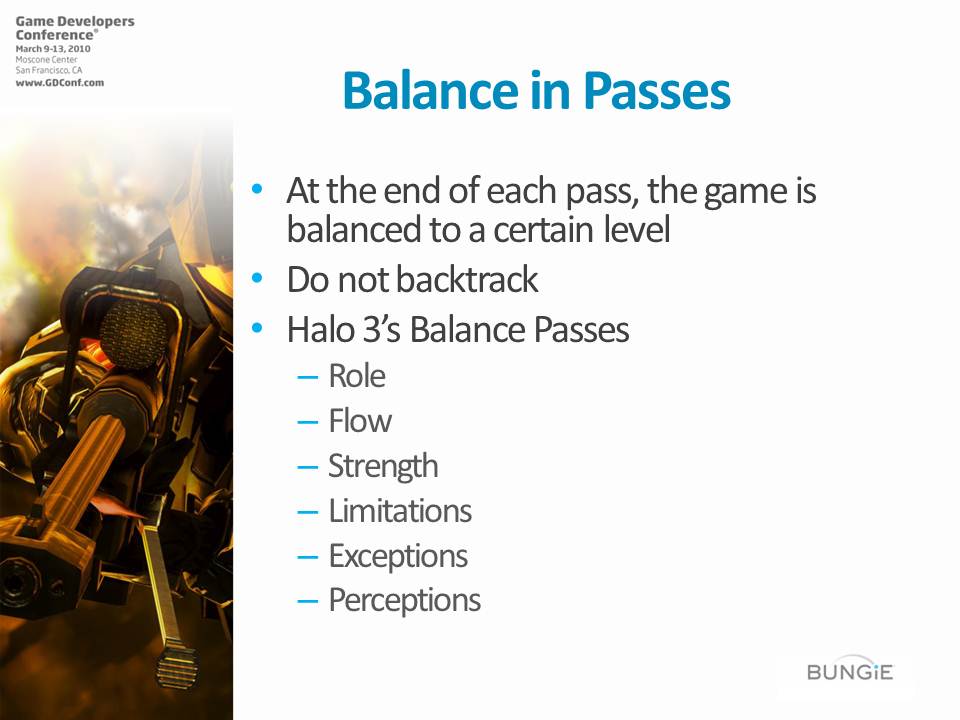
At the end of each pass, the game is balanced to a certain level.  Once a game is balanced to that level, do not backtrack.  Basically, what this means is that if you have balanced the strength of a game element, don’t make it weaker in order to limit the roles of that element.  Unless you have to, of course, in whic case it will impact the schedule so you need to let Production know.

Halo 3’s Balance Passes are listed here.  I think they would work for most games.  They match with stages of game development and I’ll go over them in more detail later.


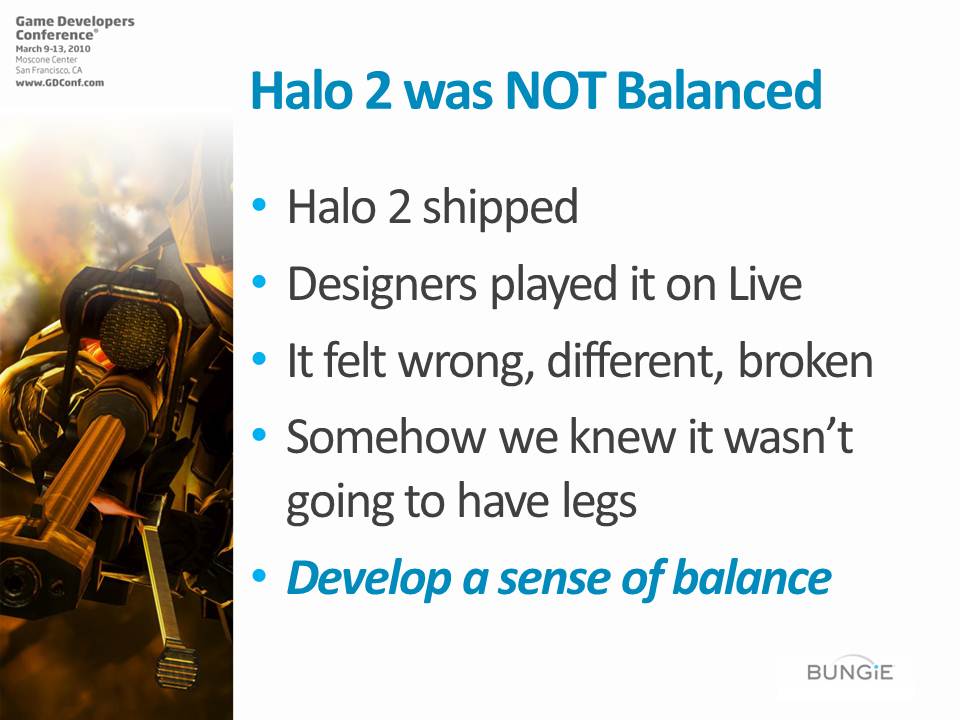
Remember: Balance is Longevity.  And we could tell by playing it that it wasn’t going to last.  We all had the same feeling and we didn’t really doubt it.  But how did we know?  We had developed our sense of balance.


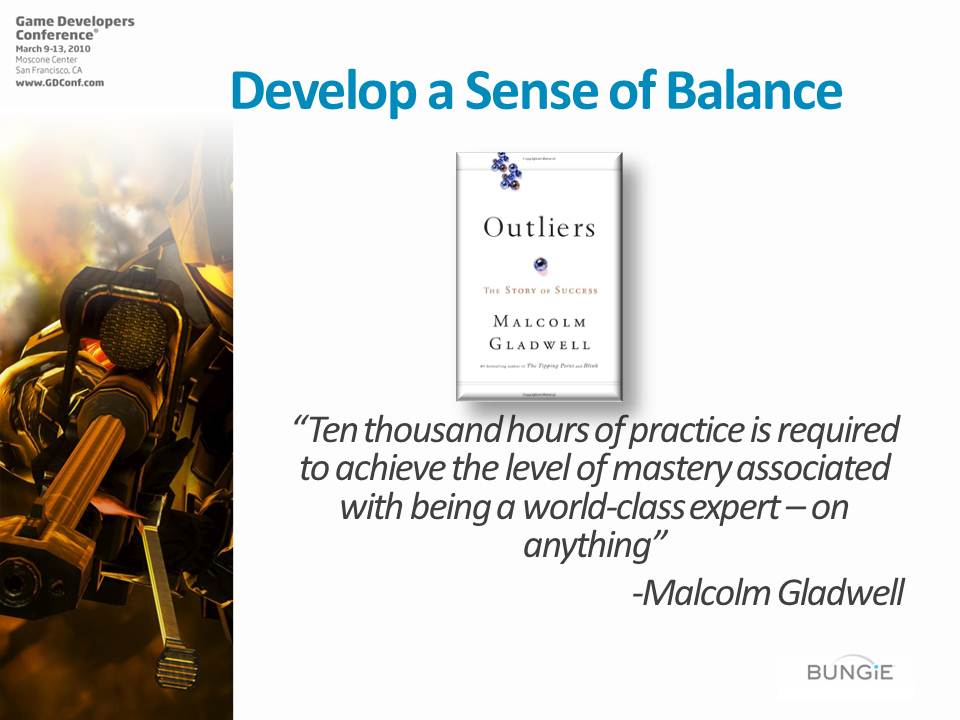
In Outliers, Malcolm Gladwell lays out his 10,000 hour rule.  This makes me the world’s only expert in trying to balance the Halo Sniper Rifle.  Sort of a narrow expertise, I admit.

Niels Bohr offers this definition of an expert.  This also makes me the world’s foremost expert in trying to balance the Halo Sniper Rifle (and in Driving too Fast for Conditions.)

But what are time and mistakes? They are just experience.  So why is experience so much more important to being an expert than training, knowledge or talent?  Because of how your brain works.

[Continue]

Reciprocal Difficulty

Push on the wall.  This is not a metaphorical encouragement to seek innovative solutions.  Literally, place your hands against a wall and give it a shove.  Now, assuming that you are not working in a cubicle, you have just experienced what physicists call a normal force.  The wall pushed back against your hands with the exact same force you used on the it.

Purchase Gotham City Mutual's Superman Insurance!

Unless you have superhuman strength... Sorry Superman

One of the prerequisites of a flow experience (as defined by Mihaly Csikszentmihalyi in his seminal work Flow: The Psychology of Optimal Experience) is that the difficulty of the activity roughly match the ability level of the participant.  If it is too easy, they will not become completely absorbed and lose themselves in the activity.  If it is too hard, they will become frustrated and unable to make continual progress.  Balancing between these two extremes is the responsibility of the game designer, but often there is not a single setting that works for every player.

One solution is to allow each player to choose their own difficulty level before starting the game.  Unfortunately, the vast majority of players simply choose the default option in their haste to start playing.  Very few players will admit to needing to play on Easy difficulty, and even good players may be too intimidated to start out on Hard.

Every answer seems insulting

I'm tough like week-old bread

Another solution is to dynamically change the difficulty of the game based on an ongoing evaluation of the player’s skill.  But in practice, this automated system usually destroys the intended pacing of the game.  A well-designed game will have periods of less challenge that lead to a more difficult section, building and relieving tension through the gameplay.  A dynamic difficulty system that is too sensitive will add wild fluctuations on top of these natural curves, obscuring the overall effect and flattening out the tension.  One that is tuned to adjust more slowly will often react to the easier segments by ratcheting up the difficulty at the same time that the designer is increasing it for pacing reasons, resulting in an unintentionally large difficulty spike.  Not to mention that the player’s sense of accomplishment will be undercut if they realize the game is “letting them win” by compensating for their low skill levels or “cheating” by getting harder as they get better.

A better solution is to learn from the wall’s normal force and design mechanics that match the player’s skill with reciprocal difficulty.  (Calling this technique normal difficulty seemed confusing.)  In a game with reciprocal difficulty, the more aggressive the player is, the harder the game gets.  But when the player becomes overwhelmed and stops pushing, the game immediately gets easier.  This allows players of all skill levels to be challenged; a good player will play more aggressively until the game gets hard enough, and a less skillful player will proceed at a slower pace until the game gets easy enough.

Examples of reciprocal difficulty mechanics:

  • Recharging Health – If a player is too aggressive and tries to fight too many enemies, they will die quickly, but as soon as they withdraw from combat their health recharges and they can proceed more carefully.
  • Defensive AI – Enemies that are much more effective when fighting from a defensive position are naturally more difficult when the player is pushing hard against them, but allows a timid player to pick them off slowly without putting pressure on them by chasing them.
  • Optional Objectives – Puzzle games that can be solved simply by any player, but have optional collectibles or rewards for completing a puzzle in fewer moves provide more challenge for better players.
  • High Scores – Any mechanic that encourages players to play for a faster time or to score more points is better able to satisfy a variety of player skill levels.
  • Character Leveling – If a player is having trouble with a difficult section, they can make it easier by earning experience and making their character more powerful.
  • Press Your Luck – The player is allowed to periodicaly save their progress or reduce their difficulty level, like going back to town in Diablo or repairing their aircraft in Crimson Skies, but good players will take this option less frequently.

Definition: Habituation

Habituation

The gradual reduction in sensitivity to a repeated stimulus

I got my teeth professionally cleaned this morning.  (One cavity, apparently I need to floss more.)  Now I cannot stop running my tongue back and forth over the newly polished enamel.  When I woke up today, my teeth were the farthest thing from my mind, unnoticeably insignificant.  But now I am obsessively, subconsciously, exhaustively exploring every crevice and gap.  This is a side-effect of a neural process called habituation.  As a stimulus (like “I have teeth”) is repeated, the electrical and chemical impact of the experience physically decreases to the point where it drops out of conscious thought, and then subconscious awareness, and eventually it is not felt at all.

You can get used to anything

As a human, this is a very good thing.  Imagine trying to have a conversation while consciously aware of the sound of your own heart pumping, the movement of your lungs breathing in and out, every blink interrupting your train of thought, unable to stop noticing the pressure of the chair into your back or ignore the ambient noise of other conversations.  It would be impossible to function.  Habituation allows you tune out the vast majority of unimportant details and focus on what is new and interesting, like how smooth your molars have become.  It’s a miraculously efficient process that allows our embarrassingly under-powered brains to filter enormous amounts of sensory information.

As a player, habituation is what allows us to learn to play a game and subsequently master it.  Our ability to predict future events based on current conditions is inseparably dependent on our habituation to past events.  A chess master learns to ignore the thousands of poor, but still possible, potential moves and consider only the strategically significant ones.  A skilled Halo player moves through a multiplayer map without thinking about it, using all of his attention to scan for his opponents.  When Mario reaches the edge of a ledge, pressing the “A” button always makes him jump.  If chess pieces could move randomly, or a Halo map suddenly had a dead-end instead of a corridor, or the “A” button threw a fireball, the player would be unable to play the game effectively.

Watch out for the Queen!

Alternative ways to make chess more interesting

But as a game designer, habituation is your mortal enemy.  A tireless, inexhaustible foe, mindlessly obviating the best efforts of your craft, which you can only hope to delay, but never defeat.  Fun gameplay is an interactive experience, and habituation inevitably reduces every experience to meaningless static.  To some extent, the purpose of every design trick and tactic is to disrupt habituation, to resensetize players to the fun experience and help them continue to enjoy the game.  We are hacking our own mental hardware, making it less-efficient.

The truly nefarious nature of this enemy lies in how sneaks into the design process itself.  Designers can learn to ignore glaring problems that would annoy or aggravate a new player.  Or they can overlook logical loopholes that will wreck the game balance because they are familiar with how the game is “supposed” to be played.  Or they might wrongly believe an element has been properly tuned because they are no longer sensitive to the effect it has on gameplay.  Understanding and controlling habituation, both their player’s and their own, is a crucial design skill.

User Research Advocacy

Warning: IdeasThroughout my career I have been a strong proponent of User Research and have taken advantage of every opportunity to investigate the desires, expectations and reactions of actual gamers.  Designing from a single perspective leads to a one-dimensional game, which is why honest answers to authentic questions is so valuable.  I don’t see that writing a blog is any different, and since I have been getting a lot of traffic lately (Hi GAFers!) I thought I would do some reader research.